what is the root closest to one of the equation tan(x) cos(x) = log(x)
Tangent
Tangent, written as tan(θ), is 1 of the six fundamental trigonometric functions.
Tangent definitions
There are 2 principal ways in which trigonometric functions are typically discussed: in terms of right triangles and in terms of the unit circle. The correct-angled triangle definition of trigonometric functions is nigh often how they are introduced, followed by their definitions in terms of the unit of measurement circle.
Right triangle definition
For a right triangle with 1 astute angle, θ, the tangent value of this angle is defined to be the ratio of the opposite side length to the adjacent side length.
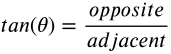
The sides of the right triangle are referenced equally follows:
- Adjacent: the side side by side to θ that is not the hypotenuse
- Opposite: the side reverse θ.
- Hypotenuse: the longest side of the triangle opposite the right angle.
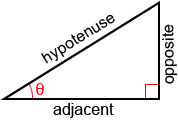
The other two most commonly used trigonometric functions are cosine and sine, and they are divers as follows:
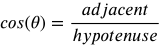
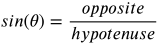
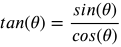
Tangent is related to sine and cosine equally:
Case:
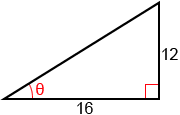
Find tan(θ) for the correct triangle below.

We tin also utilise the tangent function when solving real world problems involving right triangles.
Case:
Jack is standing 17 meters from the base of a tree. Given that the angle from Jack'south anxiety to the top of the tree is 49°, what is the summit of the tree, h? If the tree falls towards Jack, volition it land on him?
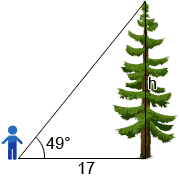
Since we know the adjacent side and the angle, we can employ 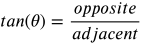 to solve for the height of the tree.
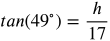
h = 17 × tan(49°) ≈ xix.56
And so, the top of the tree is 19.56 m. If Jack does not move, the tree will country on him if it falls in his direction, since 19.56 > 17.
Unit circle definition
Trigonometric functions tin can too exist divers with a unit circumvolve. A unit circle is a circumvolve of radius 1 centered at the origin. The right triangle definition of trigonometric functions allows for angles between 0° and 90° (0 and  in radians). Using the unit circle definitions allows the states to extend the domain of trigonometric functions to all real numbers. Refer to the figure below.
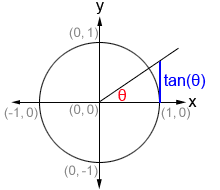
On the unit circle, θ is the angle formed between the initial side of an angle along the x-axis and the terminal side of the angle formed by rotating the ray either clockwise or counterclockwise. On the unit circumvolve, tan(θ) is the length of the line segment formed by the intersection of the line ten=one and the ray formed by the terminal side of the angle every bit shown in blue in the figure above.
Unlike the definitions of trigonometric functions based on right triangles, this definition works for whatsoever angle, not only acute angles of right triangles, equally long every bit it is within the domain of tan(θ), which is undefined at odd multiples of xc° (). Thus, the domain of tan(θ) is θ∈R, 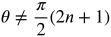 . The range of the tangent function is -∞<y<∞.
Values of the tangent function
There are many methods that can exist used to determine the value for tangent such as referencing a table of tangents, using a calculator, and approximating using the Taylor Series of tangent. In most practical cases, it is non necessary to compute a tangent value by hand, and a tabular array, calculator, or some other reference will be provided.
Tangent computer
The following is a calculator to find out either the tangent value of an angle or the bending from the tangent value.
Ordinarily used angles
While nosotros can notice tan(θ) for any bending, there are some angles that are more than oftentimes used in trigonometry. Below is a table of tangent values for commonly used angles in both radians and degrees.
| Angle in degrees | Angle in radians | Tangent value | Tangent value in decimals |
|---|---|---|---|
| 0° | 0 | 0 | 0 |
| xv° |  |  | 0.268 |
| 30° |  |  | 0.577 |
| 45° |  | one | 1 |
| sixty° |  |  | ane.732 |
| 75° |  |  | 3.732 |
| 90° |  | Undefined | Undefined |
| 180° | π | 0 | 0 |
| 270° |  | Undefined | Undefined |
| 360° | iiπ | 0 | 0 |
From these values, tangent can be determined as . Cosine has a value of 0 at 90° and a value of ane at 0°. On the other hand, sine has a value of 1 at xc° and 0 at 0°. Every bit a event, tangent is undefined whenever cos(θ)=0, which occurs at odd multiples of 90° (), and is 0 whenever sin(θ)=0, which occurs when θ is an integer multiple of 180° (π). The other commonly used angles are thirty° ( ), 45° (
 ), 60° (
 ) and their respective multiples. The cosine and sine values of these angles are worth memorizing in the context of trigonometry, since they are very commonly used, and can be used to make up one's mind values for tangent. Refer to the cosine and sine pages for their values.
Knowing the values of cosine, sine, and tangent for angles in the beginning quadrant allows us to determine their values for respective angles in the remainder of the quadrants in the coordinate aeroplane through the apply of reference angles.
Reference angles
A reference angle is an acute angle (<90°) that can be used to stand for an angle of any measure. Any angle in the coordinate airplane has a reference angle that is between 0° and 90°. Information technology is always the smallest angle (with reference to the x-axis) that can be made from the terminal side of an angle. The effigy below shows an bending θ and its reference angle θ'.
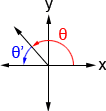
Because θ' is the reference bending of θ, both tan(θ) and tan(θ') accept the same value. For instance, 30° is the reference angle of 150°, and their tangents both have a magnitude of , albeit they take different signs, since tangent is positive in quadrant I but negative in quadrant II. Because all angles have a reference bending, we really only need to know the values of tan(θ) (every bit well every bit those of other trigonometric functions) in quadrant I. All other respective angles will have values of the aforementioned magnitude, and nosotros but need to pay attention to their signs based on the quadrant that the terminal side of the angle lies in. Below is a tabular array showing the signs of cosine, sine, and tangent in each quadrant.
| Tangent | Sine | Cosine | |
| Quadrant I | + | + | + |
| Quadrant Two | - | + | - |
| Quadrant Iii | + | - | - |
| Quadrant Iv | - | - | + |
Once nosotros determine the reference angle, we can determine the value of the trigonometric functions in any of the other quadrants past applying the appropriate sign to their value for the reference bending. The post-obit steps tin can exist used to find the reference bending of a given angle, θ:
- Subtract 360° or 2π from the angle as many times as necessary (the bending needs to be between 0° and 360°, or 0 and 2π). If the resulting bending is betwixt 0° and xc°, this is the reference angle.
- Determine what quadrant the terminal side of the angle lies in (the initial side of the bending is along the positive x-axis)
- Depending what quadrant the terminal side of the bending lies in, use the equations in the table below to find the reference bending. In quadrant I, θ'=θ.
| Quadrant Two | Quadrant 3 | Quadrant 4 |
|---|---|---|
| | 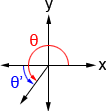 | 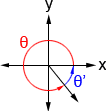 |
| θ'= 180° - θ | θ'= θ - 180° | θ'= 360° - θ |
Example:
Find tan(240°).
- θ is already betwixt 0° and 360°
- 240° lies in quadrant III
- 240° - 180° = 60°, so the reference angle is 60°
tan(threescore°)=. 240° is in quadrant Three where tangent is positive, so: tan(240°)=tan(60°)=
Example:
Find tan(690°).
- 690° - 360° = 330°
- 330° lies in quadrant IV
- 360° - 330° = 30°
tan(30°) = . 330° is in quadrant IV where tangent is negative, so:
tan(330°) = -tan(30°) = 
Properties of the tangent function
Below are a number of properties of the tangent function that may be helpful to know when working with trigonometric functions.
Tangent is a cofunction of cotangent
A cofunction is a function in which f(A) = g(B) given that A and B are complementary angles. In the context of tangent and cotangent,
tan(θ) = cot(90° - θ)
cot(θ) = tan(90° - θ)
Example:
tan(30°) = cot(90° - 30°)
tan(30°) = cot(sixty°)

Referencing the unit circle shown above, the fact that , and 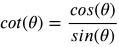 , nosotros tin can see that:
tan(thirty°) = cot(lx°) =
Tangent is an odd function
An odd function is a part in which -f(ten)=f(-x). It has symmetry nigh the origin. Thus,
-tan(θ) = tan(-θ)
Instance:
-tan(30°) = tan(-30°)
-tan(30°) = tan(330°)
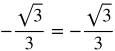
Referencing the unit circumvolve or a table, nosotros can find that tan(30°)=. tan(-30°) is equivalent to tan(330°), which nosotros determine has a value of . Thus, -tan(30°) = tan(330°) = .
Tangent is a periodic function
A periodic part is a office, f, in which some positive value, p, exists such that
f(x+p) = f(ten)
for all 10 in the domain of f, p is the smallest positive number for which f is periodic, and is referred to as the menses of f. The period of the tangent office is π, and it has vertical asymptotes at odd multiples of . We can write this equally:
tan(θ+π) = tan(θ)
To account for multiple full rotations, this can also be written as
tan(θ+nπ) = tan(θ)
where n is an integer.
Unlike sine and cosine, which are continuous functions, each catamenia of tangent is separated by vertical asymptotes.
Case:

tan(405°) = tan(45° + 2×180°) = tan(45°) = one
Graph of the tangent function
The graph of tangent is periodic, pregnant that it repeats itself indefinitely. Different sine and cosine notwithstanding, tangent has asymptotes separating each of its periods. The domain of the tangent office is all existent numbers except whenever cos(θ)=0, where the tangent role is undefined. This occurs whenever 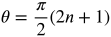 . This can exist written every bit θ∈R, . Below is a graph of y=tan(x) showing 3 periods of tangent.
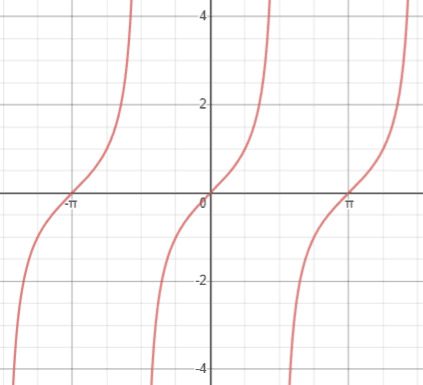
In this graph, we can see that y=tan(x) exhibits symmetry near the origin. Reflecting the graph across the origin produces the aforementioned graph. This confirms that tangent is an odd office, since -tan(x)=tan(-x).
Full general tangent equation
The full general form of the tangent role is
y = A·tan(B(x - C)) + D
where A, B, C, and D are constants. To be able to graph a tangent equation in general course, we demand to first understand how each of the constants affects the original graph of y=tan(x), as shown to a higher place. To use annihilation written beneath, the equation must exist in the grade specified above; be careful with signs.
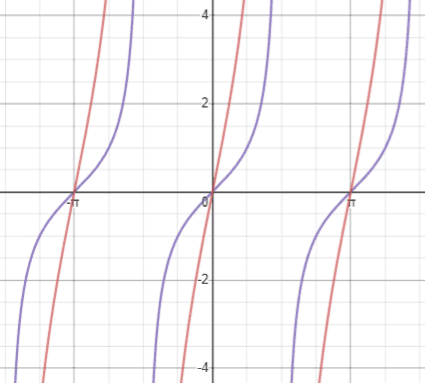
A—the amplitude of the function; typically, this is measured as the height from the centre of the graph to a maximum or minimum, as in sin(ten) or cos(x). Since y=tan(ten) has a range of (-∞,∞) and has no maxima or minima, rather than increasing the height of the maxima or minima, A stretches the graph of y=tan(x); a larger A makes the graph approach its asymptotes more quickly, while a smaller A (<1) makes the graph approach its asymptotes more than slowly. This is sometimes referred to as how steep or shallow the graph is, respectively.
Compared to y=tan(x), shown in royal below, the role y=5tan(ten) (ruby) approaches its asymptotes more steeply.
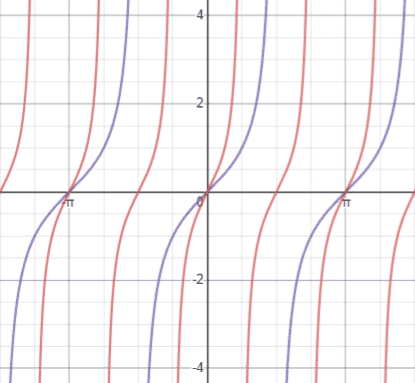
B—used to make up one's mind the flow of the function; the period of a function is the distance from superlative to peak (or any point on the graph to the side by side matching point) and can exist institute every bit  . In y=tan(ten) the menses is π. We can ostend this past looking at the tangent graph. Referencing the figure above, nosotros tin can see that each menstruum of tangent is divisional by vertical asymptotes, and each vertical asymptote is separated by an interval of π, so the menstruation of the tangent function is π.
Compared to y=tan(x), shown in majestic below, which has a menstruum of π, y=tan(2x) (crimson) has a period of  . This ways that the graph repeats itself every rather than every π.
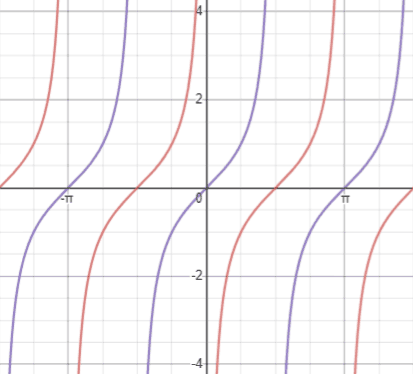
C—the phase shift of the role; phase shift determines how the office is shifted horizontally. If C is negative, the function shifts to the left. If C is positive the office shifts to the right. Be wary of the sign; if we take the equation 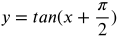 then C is
  not , because this equation in standard form is
 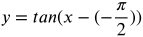 . Thus, we would shift the graph units to the left.
The figure beneath shows y=tan(x) (purple) and (red). Using the zero of y=tan(x) at (0, 0) equally a reference, we tin can run into that the same zero in has been shifted to (, 0).
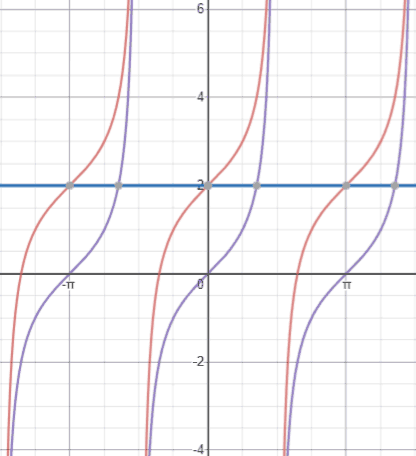
D—the vertical shift of the office; if D is positive, the graph shifts upwards D units, and if it is negative, the graph shifts down.
Compared to y=tan(x), shown in purple below, which is centered at the x-centrality (y=0), y=tan(x)+2 (scarlet) is centered at the line y=2 (blue).
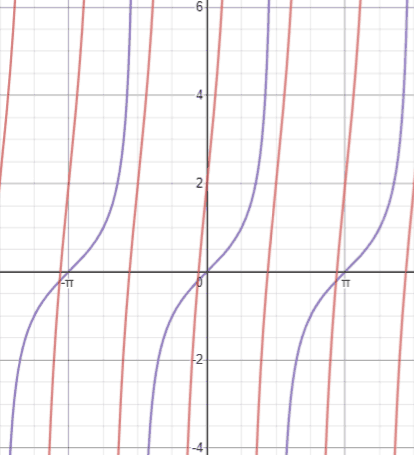
Putting together all the examples above, the effigy beneath shows the graph of 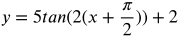 (red) compared to that of y=tan(10) (purple).
Encounter likewise sine, cosine, unit circumvolve, trigonometric functions, trigonometry.
cassityovelinterst.blogspot.com
Source: https://www.math.net/tangent
0 Response to "what is the root closest to one of the equation tan(x) cos(x) = log(x)"
Post a Comment